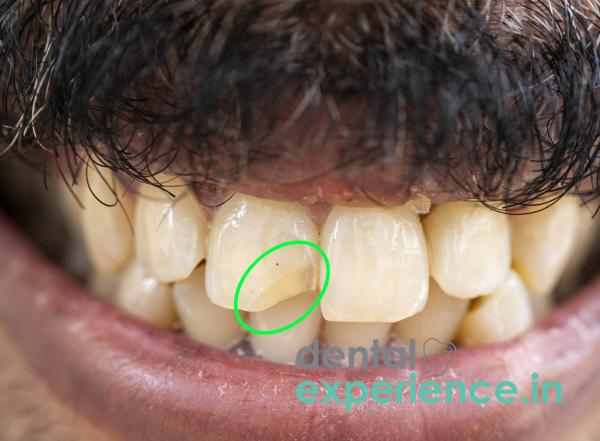
A chipped front tooth is one of the most common types of structural damage that modern dentistry treats. Although it is often viewed as a minor cosmetic issue that fits under the umbrella of size and shape problems, physical trauma to or structural failure of the anterior teeth can compromise all of the biologic and mechanical aspects of your bite. The enamel covering your tooth is the hardest substance in the human body. However, it is brittle and prone to cracking under sudden mechanical stresses. Once your enamel cracks, you are at increased risk for further structural collapse of the tooth, possible nerve exposure and/or increasing amounts of bacterial invasion that will cause more severe dental decay.
A chipped front tooth is a crack or break through the outermost layer of the tooth called the enamel or possibly through the softer layer beneath it called the dentin.
The primary core risk associated with a chipped front tooth is that it progresses from being a cosmetic size and shape issue to becoming a serious structural damage issue or even a painful root canal infection.
Primary treatment options: Composite bonding, porcelain veneers, and full dental crowns.
Cost in Kerala: Composite bonding: ₹2,500 – ₹6,000; Porcelain veneers: ₹8,000 – ₹25,000; Zirconia crown: ₹10,000 – ₹20,000
Depending upon how deep your structural damage goes, you may or may not notice a variety of different symptoms.
Commonly patients report noticing changes in the symmetry, shape or size of their smile. Physical contact with a jagged edge created by a broken tooth usually results in additional complications including the sharp cutted edge creating cuts in the tongue or cheek lining.
If your fracture has progressed to involve more than just the enamel and extends into the dentin, you may start to experience some level of temperature sensitivity. Depending upon how deep your fracture extends, this sensitivity could be mild or moderate and may result from eating foods/drinks that are very hot or very cold.
In extreme cases where the pulp chamber is involved, your symptoms can quickly become much more pronounced and painful. At this point, you might develop a sharp, throbbing type of pain around the tooth. Swelling of the soft tissues surrounding the tooth and pain while chewing may also occur.
As mentioned above, minor surface-level chips rarely represent an emergency. Specific clinical warning signs do exist that indicate you need to seek immediate dental care.
If your fractured tooth is causing you persistent, spontaneous throbbing-type pain then you should seek emergency dental care immediately because this indicates that inflammation/pulpitis has occurred.
Additionally, if you can visually observe pink, red or dark colored spots in the exposed areas of your fracture this is indicative of pulpal exposure.
Finally, if your tooth has become unstable; displays significant color changes (i.e., turns gray/black); or if you experience bleeding from the gums adjacent to the fracture site these represent advanced structural damage/root fractures and ignoring them may result in death of your dental nerve or development of a systemic dental abscess.
There are several reasons why your tooth could fracture. Common causes include:
Direct trauma: Examples include sports-related injuries, falling onto a hard object (e.g., pavement), vehicle collisions on busy streets etc.
Masticatory accidents: Accidental biting down on hard objects (e.g., unpopped corn kernel, stone in fruit etc.)
Parafunctional habits: Using your teeth as tools to open plastic packages etc.; chronic bruxism (grinding your teeth).
Underlying enamel weakness: Pre-existing large composite fillings or small micro-fractures weakening the overall structural integrity of the tooth over time.
Certain underlying conditions greatly increase your chances of developing structural damage to your anterior teeth.
Conditions such as untreated GERD or extremely acidic diets can wear away your enamel layer leaving behind a thin brittle shell susceptible to cracking under normal chewing forces.
Malocclusion i.e., buck-teeth/severely overlapping upper/lower incisors expose your teeth to excessive amounts of facial impacts and therefore put them at greater risk for structural damage.
Furthermore, individuals with large old composite restorations on their anterior teeth have a higher risk for future fractures because the interfaces between the filling material and the natural tooth structure degrade with age resulting in weakened natural tooth structure that is now vulnerable to sudden fracturing under regular chewing forces.
You cannot receive an official diagnosis without consulting a professional; however, you can make an initial self-assessment based upon what you can visually inspect.
Begin by washing your hands thoroughly and then gently run your tongue along or place a clean finger against the chipped side of your tooth to determine if you feel any sharp jagged edges that may cut your tongue.
Next stand in front of a mirror in a bright lit room to view your tooth. Determine whether you simply have an irregular shaped tooth or if you see a visible yellow layer (dentin) below your enamel or pink spot (nerve). Gently tap each side of your tooth with a clean finger to assess if there is any abnormal looseness or sharp wave of pain indicating there is more going on structurally than what you can initially see.
An official diagnosis of a chipped front tooth can only be made after undergoing a complete clinical exam performed by a qualified dentist. After conducting a visual exam and utilizing a dental explorer to define the perimeter of your fracture and search for other smaller micro-fractures that may be present. The dentist will take intraoral peri-apical (IOPA) X-rays/digital radiographs to get an accurate measurement of the extent of your structural damage .
Standard health care providers use three separate grades to classify degrees of structural damage experienced by individual teeth.
|
Degree |
Structural Extend |
Clinical Presentation |
|
Grade I (Minor) |
Enamel only |
Surface-level chip with minor irregularity in shape/size No pain/sensitivity |
|
Grade II (Moderate) |
Enamel & Dentin |
Sensitivity Yellow dentin layer exposed Sharp edges |
|
Grade III (Major) |
Pulpal involvement |
Nerve exposed Bleeding Throbbing pain |
Treating structural damage experienced by individual teeth requires methods specifically matched to the degree of structural damage involved.
Mild/Moderate structural damage is best addressed using composite bonding for a chipped front tooth as this method produces reliable results at an affordable price-point.
For more extensive structural damage covering a larger surface area or requiring significant shape reconstruction, dental veneers offer a suitable choice as they provide excellent structural durability/stain-resistance options.
|
Treatment Type |
For which condition? |
Approximate Cost |
|
Laser contouring/ Smoothing |
Sharp edges and Minor cracks |
₹1,500 – ₹3,000 |
|
Composite Dental Bonding |
To solve small and moderate level cracks |
₹2,500 – ₹6,000 |
|
Root Canal Treatment |
Broken teeth and Decays and infection involving pulp |
₹3,500 – ₹8,000 |
|
Porcelain or EMax Veneers |
Modern cosmetic treatment to correct shape and size of tooth |
₹8,000 – ₹25,000 |
|
Porcline Fused Metal Crown (PFM) |
For severe cracks (Low budget option) |
₹4,000 – ₹7,000 |
|
Premium Zirconia Crown |
For severe cracks. Advanced option with high level of aesthetics |
₹10,000 – ₹20,000 |
For less complicated cases involving only superficial enamel chips, general dentists are capable of handling repairs alone. Advanced structural damage that breaches multiple layers or requires more complex procedures may benefit from specialty services offered by either prosthodontists/cosmetic dentists. Additionally, endodontists specialize in saving teeth experiencing advanced root fractures before placing final crowns/veneers on restored roots.
Your urgency levels will depend on your specific symptoms.
Minor (surface-level): Minor surface-level chips are never medical emergencies.
Moderate (deeper fracture): More significant surface-level fractures may require immediate attention.
High/Urgent: Severe fractures with significant pain, bleeding or nerve exposure are considered emergencies.
Does a chipped tooth ever "heal" itself?
A tooth chip will not self-heal. Dental enamel does not have live cells in it; therefore, it cannot repair itself through cell division or healing. You will need to see a dentist for the necessary repairs.
How long do the results of a composite bonded front tooth usually last?
Composite bonding results may vary depending on several factors including, but not limited to, patient oral hygiene, para-functional behaviors such as nail biting and the type of material used. Generally speaking, most people get anywhere from five to seven years out of a composite bonded tooth before needing some type of follow up or replacement work done.
Are veneers or crowns painful to put in place?
Veneers and Crowns are both relatively simple procedures. Most minor bonding applications do not require anesthesia. The application of a local anesthetic is required for both veneers and crowns to prevent discomfort during the placement. Therefore, these are entirely pain free.
Conservative and minimally invasive techniques are highly valued in today's restorative dentistry world. Both composite bonding and porcelain veneers allow dentists to maintain as much of the original structure of the tooth as possible, yet still allow them to restore the natural contours of the tooth. However, dentists always remind their patients that ignoring even small amounts of structural damage can result in continuous weakening of the remaining tooth enamel and micro-leakage. Promptly identifying and addressing structural issues now helps eliminate potential future problems with root infections and protects the structural and esthetic life of their smile.








.jpg)
.jpg)
.jpg)
.jpg)
.jpg)
.jpg)
.jpg)
.jpg)
.jpg)
.jpg)
.jpg)
.jpg)