Each tooth exists within the overall maxillofacial structure as part of a system in constant balance. The teeth provide both the structural support needed for vertical occlusal stability through the antagonist contact of the opposing unit and also the mesio-distally stable support for neighboring teeth. Therefore, the loss of this support results in a series of unfortunate events, beginning with the lack of mechanical loading necessary to maintain the alveolar bone (the bone holding all tooth sockets) from undergoing rapid resorption. Loss of the alveolar bone will result in the structural collapse of the vertical dimension of occlusion (VDO), which diminishes lower facial height and places unnecessary stress on the TMJ.
Additionally, partial edentulism is classified according to location and surrounding anatomical features. There are several classification systems used to map partial edentulism, the most universally adopted being the Kennedy Classification system, which categorizes edentulous spaces based on their location relative to the remaining teeth to guide mechanically sound restorative designs.
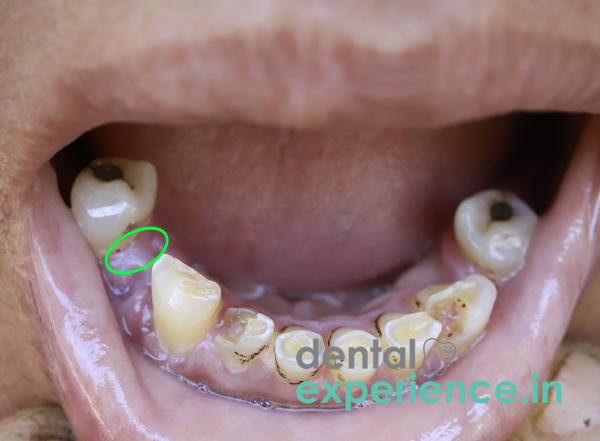
Definition: Clinically defined partial edentulism is characterized by the loss of two or more teeth in either or both dental arches. As a consequence of the loss of the tooth support, there is resultant bone loss and subsequent displacement (shift) of the remaining teeth.
Signs/Symptoms: Posterior bite collapse, difficulty chewing staple regional foods, shifting of adjacent teeth, TMJ discomfort/pain, and visually noticeable hollowing of the cheek.
Treatments: Multiple dental implants, Implant supported bridges, Conventional fixed partial dentures (FPDs), and Removable cast partial dentures (CPDs).
Prevention: Early interceptive treatment of gingivitis and chronic periodontitis, along with timely restoration of decayed teeth.
Decrease in masticatory efficiency: The individual's ability to crush fibrous/hard foods is significantly impaired. Therefore, he/she must limit his/her diet to soft foods only.
Functional shift and drift: The remaining teeth appear to tip/tilt/rotate into the gap(s) created by the missing tooth(es). Shifting adjacent teeth creates food trapping sites.
Supra eruption: The opposing tooth against the empty space appears to grow outward from its socket due to lack of antagonistic occlusal force.
Speech pattern changes: Difficulty articulating sibilant ("s", "z") and labiodental ("f", "v") sounds because air escapes uncontrollably from the empty spaces.
Collapse of esthetic soft tissue: Sunken appearance of cheeks/thinning lips due to absence of bony hard tissue support provided by lost tooth/alveolar bone.
While missing teeth might seem like a passive condition, there are several warning signs that indicate serious clinical concern and require prompt evaluation to prevent irreversible skeletal damage.
Pain/clicking/popping in TMJ: This indicates the new bite position has disrupted the normal functioning of the mandible, thus initiating inflammatory changes within the joint itself.
Excessive mobility of remaining teeth: Indicates secondary occlusal trauma, where remaining teeth with already weakened bone support are overwhelmed by normal or increased biting forces, leading to progressive tooth looseness.
Chronic bleeding and gum recession: Suggests that active destruction of the supportive alveolar bone continues due to untreated chronic periodontitis.
Sharp Pain upon biting down: Develops when a previously healthy tooth undergoes micro fractures due to abnormal occlusal forces applied during chewing actions after a tooth has drifted into an unfavorable position.
Advanced periodontitis: Chronic bacterial infection of the gingival tissues and periodontal ligament that destroys alveolar bone, causing progressive tooth mobility (looseness) and ultimately tooth loss.
Failure of old restorations: Aged, poorly maintained bridges or failed endodontic treatments lead to the necessary extraction of multiple anchor teeth.
Mechanical damage: Traumatic injuries to teeth due to severe physical impacts from motorcycle accidents/falls/fracturing/multiple root fractures/or avulsion of a tooth.
Dietary habits in region: High sugar intake from consuming large amounts of refined carbohydrates/sticky sweet native candies/starch-based foods like parottas/rice which contribute to quick accumulation of biofilm plaque on teeth surfaces.
Systemic disease: Type 2 diabetes mellitus-uncontrolled cases impair peripheral healing and increase rate of bone resorption of alveolar bone.
Use of tobacco products: Smoking/chewing tobacco products constrict local blood vessels(vasoconstriction); mask symptoms of early stages gum disease; and destroy soft tissue.
Elderly: Normal aging process leads to atrophy of oral mucous membrane; decrease in salivation(xerostomia) ; increases susceptibility for rapid progression of carious lesions.
Carefully evaluate your mouth before your appointment so you can provide your dentist with an accurate history of your symptoms and structural changes.
Count empty spaces and determine if adjacent teeth are mesially drifting:
Open your mouth wide with a good source of natural daylight. Count the number of spaces where you no longer have a tooth present. Determine if the adjacent teeth appear to be leaning toward the void created by the missing tooth.
Check opposite tooth length: Carefully examine whether the teeth opposite the empty space appear longer than their neighbor, indicating supra eruption.
Observe occlusion/bite position: Close your mouth gently and observe your bite. Identify if your anterior teeth overlap more than usual; or if your jaw must slide left/right to comfortably come together and rest.
Inspect soft tissues over missing teeth: Look carefully at the gums covering the spaces where you once had teeth. Identify any area that appears unusually thin/Sunken/red/inflamed.
Comprehensive clinical examination using various forms of imaging and structural testing is required for accurate diagnosis.
Orthopantomogram (OPG): Two dimensional X ray image that shows complete overview of both arches, empty spaces/bone levels/root status of remaining teeth.
Cone Beam Computed Tomography (CBCT): Three dimensional imaging modality essential for planning placement of dental implants. Measures height/width/density of existing alveolar bone down to a mm level.
Diagnostic models/digital models/articulation: Creating replicas/models (digital or physical) of your upper/lower arches to study how upper and lower arches interact dynamically.
Probing: Measures depth/proximity of remaining teeth pockets around remaining teeth to determine whether they have sufficient structural integrity to support a bridge/partial denture
Clinical Presentation (Kennedy Class) |
Clinical Characteristics |
Structural Impact |
Mild (Kennedy Class III / IV) |
2–3 missing teeth bounded by healthy teeth on both sides. |
Minimal bone loss; localized shifting; minor chewing inefficiency. |
Moderate (Kennedy Class II) |
Multiple missing teeth on one side, including the back molars (free-end saddle). |
Moderate bone resorption; posterior bite collapse; joint strain begins. |
Severe (Kennedy Class I) |
All back teeth missing on both sides of the arch. |
High bone loss; severe VDO reduction; facial sagging; heavy stress on front teeth. |
There have been many modern advancements in treating patients who are suffering from multiple missing teeth. As well as being aesthetically pleasing, modern treatments provide good biocompatibility and structural integrity, thus providing a great solution to this common problem.
Multiple dental implant: Each dental implant is an individual titanium post or zirconia post that is inserted directly into the mandible or maxilla. In other words these implants act as artificial tooth roots. Titanium and zirconia are both very biocompatible and will undergo osseointegration. Osseointegration means that the surrounding bone cells attach to the surface of the implant creating a solid bond. This provides the best possible treatment as it helps preserve the bone health around each dental implant.
Implant supported bridge: Two or more dental implants can be used as anchor points to support a fixed bridge containing several artificial teeth. Instead of having an implant for each tooth space, fewer dental implants will reduce the number of surgical interventions and therefore reduce the overall expense of the treatment. However, the benefit of having a few dental implants instead of one for each tooth space does mean that each artificial tooth will be supported by at least two dental implants, thus providing greater stability.
Fixed partials (bridges): Unlike dental implants, a conventional fixed bridge utilizes adjacent healthy teeth as anchors (abutment) to support a suspended artificial tooth (pontic). When preparing healthy teeth to serve as anchor points (abutments), a significant layer of the tooth's outer enamel and underlying dentin must be permanently reduced to accommodate the crown framework. Although this type of treatment is also viable for quick temporary solutions for tooth loss, it is generally considered inferior to dental implants because healthy adjacent teeth are damaged to support the pontic and cannot be restored once this damage occurs.
Cast Partial Dentures (CPDs): A cast partial denture is a removable appliance consisting of a high-quality alloy framework and artificial acrylic teeth. The cpd is a durable and cost-effective alternative for replacing missing teeth. It is able to distribute chewing pressure among the remaining teeth and the surrounding tissues.
In addition to the type of restoration chosen, the overall cost for replacing multiple missing teeth in Kerala can vary greatly depending upon the selected materials and clinic facilities. Also, additional costs may be required for procedures such as bone grafting (which typically adds ₹8,000 to ₹25,000 per site depending on complexity).
Conventional fixed bridges: ₹4,000 to ₹15,000 per tooth unit (depending on whether standard PFM [Porcelain Fused to Metal] or premium zirconia is used).
Removable Cast Partial Dentures (CPDs): ₹15,000 to ₹25,000 for a full single arch framework.
Dental implants (Per Unit): ₹25,000 to ₹60,000 per implant (largely dependent on global manufacturing brands – i.e., budget-friendly Korean systems vs. premium Swiss systems like Straumann, excluding the final crown).
Implant-supported bridge (full segment/arch): ₹1,50,000 to ₹5,50,000+ (heavily influenced by the number of implants used, e.g., All-on-4 vs All-on-6 setups, and the complexity of bone volume enhancement).
Most simple extractions and regular removable acrylic appliances may receive some reimbursement through various local government healthcare schemes or corporate health insurance packages. However, most dental implants and premium crown materials are strictly classified as elective, out-of-pocket procedures.
Prosthodontist: As a dental specialist, prosthodontists focus solely on the restoration and replacement of missing teeth with advanced fixed or removable prosthetics. They specialize in complex full-mouth rehabilitations.
Oral & maxillofacial surgeons: Highly skilled in performing complex surgical extractions, bone grafting, and placing dental implants in the exact position needed for optimal function.
Periodontists: Essential for patients with advanced periodontal disease; periodontists manage the disease progression of the supporting bone and gum tissues so that any future bridge or implant has a stable foundation
Missing teeth do not necessarily create an "emergency" situation unless they were lost immediately due to acute trauma. Prompt evaluation by a dentist is recommended in either event as follows:
Emergency Care: If teeth are lost immediately due to acute trauma, emergency care should be sought immediately to evaluate soft-tissue lacerations and determine whether any teeth can be replanted or stabilized.
1 to 3 Months: The ideal window to plan replacements following extractions. This timing allows soft-tissue healing prior to onset of bone resorption and tooth drift.
After 6 Months: Elective but critical. Failure to provide timely treatment results in measurable loss of bone volume that may require expensive bone grafting surgery later.
Will I be okay if I simply live with multiple missing back teeth since they are not visible?
Even though the aesthetic impact on your smile may not seem significant, missing posterior teeth cause posterior bite collapse. Therefore, your anterior teeth become subjected to increased grinding forces than they were originally intended for causing rapid wear, splaying and eventually looseness of your front teeth.
Is the dental implant process uncomfortable for multiple missing teeth?
The dental implant procedure takes place under deep local anesthesia or conscious sedation allowing you to feel nothing during the time of surgery. With use of prescribed anti-inflammatory medications your postoperative discomfort will be manageable and will generally subside within three to five days.
How long do artificial teeth last compared to conventional bridges?
While the underlying dental implant posts integrate into your jawbone and can last a lifetime with proper hygiene, the artificial teeth attached to them may experience normal wear and require maintenance or replacement after 10 to 15 years.
In cases where patients present with multiple missing teeth we emphasize early holistic intervention. There are no longer cosmetic considerations, only structural rehabilitation of the stomatognathic system involved when considering treatment of partial edentulism.
Delaying treatment results in unchecked alveolar bone atrophy. Thus, what was initially a relatively easy restoration case becomes a complex surgical challenge that requires bone augmentation. We strongly advocate for implant supported restorations wherever possible and bone density is adequate because they are the only therapeutic mechanisms available to preserve native bone structures. Each patient must understand that preservation of remaining natural teeth depends entirely upon timely stabilization of vacant spaces.





.jpg)
.jpg)
.jpg)
.jpg)

.jpg)
.jpg)
.jpg)
.jpg)
.jpg)
.jpg)
.jpg)
.jpg)